Blog

8
Aug
2026

What NIST 800-88 Data Sanitization Standard Actually Requires

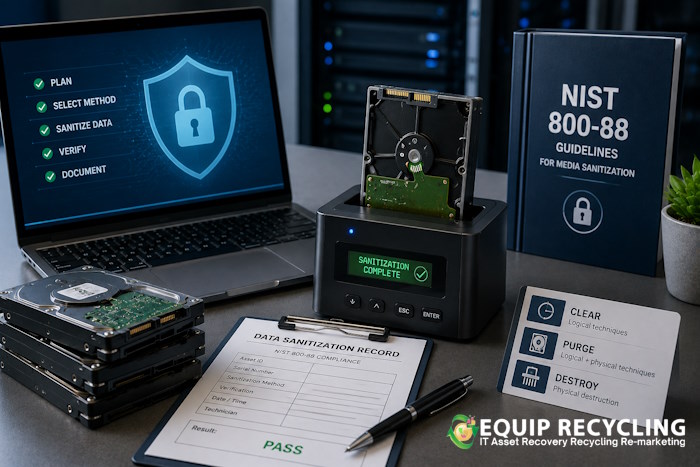
What NIST 800-88 Data Sanitization Standard Actually Requires NIST SP 800-88 is the federal guideline that most IT directors, data center managers, and compliance officers eventually encounter when decommissioning equipment or managing end-of-life media. If your organization disposes of servers, hard drives, laptops, or any electronic storage, this document defines the bar you are expected to meet. It is not technically mandatory for private industry in most cases. But it is the de facto standard that auditors, regulators, and downstream partners ask about by name. Equip Recycling works with organizations across sectors that need to demonstrate chain-of-custody compliance and verifiable data destruction. NIST 800-88 compliance. 1 is the framework we reference consistently when building destruction workflows for clients. This article breaks down what the standard actually requires, what the three sanitization categories mean operationally, and why the documentation piece matters as much as the destruction itself. Call (866) 966-4574 What NIST 800-88 Is and Why It Replaced Older Methods The National Institute of Standards and Technology published NIST Special Publication 800-88 in 2006 and released the current version, Revision 1, in December 2014. That revision is the one still in effect and the one you should be working from. The standard replaced the DoD 5220.22-M three-pass overwrite method as the primary reference for most organizations. DoD 5220.22-M was never updated to address solid-state storage, flash memory, or NVMe drives. NIST 800-88 Rev. 1 was designed from the start to be media-agnostic and to scale as storage technology evolves. It is the reason organizations that used to specify “DoD wipe” in their contracts have largely moved to specifying NIST 800-88 Purge instead. The global scale of the e-waste problem underscores why this matters. Approximately 53.6 million metric tons of electronic waste were generated globally in 2019, with only 17.4% formally collected and recycled (Source: Global E-waste Monitor 2020, United Nations University). Equipment that leaves an organization without verified data sanitization does not just create a compliance risk. It becomes part of that untracked waste stream, often ending up in jurisdictions with no enforceable data protection requirements. The Three Sanitization Categories and What They Mean Operationally NIST 800-88 defines three sanitization methods. They are not interchangeable and choosing between them depends on the sensitivity classification of the data, the media type, and the intended disposition of the hardware. Clear Clear uses logical techniques to overwrite data in all user-addressable storage locations. Standard Read/Write commands handle the overwrite, or a factory reset is applied when overwriting is not supported. Clear is appropriate for media that will be reused internally at a lower sensitivity level. It does not address unallocated space, Host Protected Areas, or Device Configuration Overlays. For HDDs being redeployed within the same organization, Clear often meets the requirement. For anything leaving the building, it typically does not. Purge Purge applies physical or logical techniques that render target data recovery infeasible even with state-of-the-art laboratory methods. This is the standard that matters for most enterprise decommissioning and ITAD work. For HDDs, Purge involves firmware-level commands that address areas outside the standard LBA address space, including defect sectors and remapped blocks. For SSDs and NVMe drives, the Purge command triggers a block erase across the entire storage array, including wear-leveled blocks that standard overwrite cannot reach. This is the critical distinction. A standard overwrite on a solid-state drive leaves recoverable data in blocks the drive controller has moved during normal wear-leveling operations. Purge addresses those areas. Overwrite alone does not. Cryptographic erasure, where the encryption key governing a self-encrypting drive is destroyed and the drive is re-keyed, also qualifies as Purge under NIST 800-88 when implemented correctly. The key word is correctly. The encryption must have been enabled before data was written to the drive, and the key destruction must be verified and documented. Destroy Destroy renders the media physically incapable of storing data. Physical shredding to a particle size specified by NIST, disintegration, incineration, and pulverizing are all listed. For magnetic media, degaussing followed by physical destruction is acceptable. For flash-based media, degaussing alone is not. Degaussing has no effect on NAND flash or NVMe storage. This distinction matters operationally and is still misunderstood in the field. “We still get shipments from clients who specified degaussing for SSDs. Degaussing an SSD does nothing to the data. The NIST guidelines are explicit on this. Media type determines the applicable destruction method, not the other way around.” — Equip Recycling Call (866) 966-4574 Why Verification Is Not Optional NIST 800-88 Rev. 1 treats verification as a required step, not an optional quality check. The standard specifies two verification approaches. First, verification applied every time sanitization is performed. Second, representative sampling verification conducted by personnel who were not part of the original sanitization action. This is where many organizations fall short. The sanitization was performed, the drives were shipped, and the assumption is that the work is done. But without serialized, asset-level verification, there is no auditable evidence that the destruction actually occurred or that it was applied correctly. Chain of custody documentation without verified sanitization records is incomplete documentation. The output of a properly executed NIST 800-88 process is a Certificate of Destruction that lists each asset by serial number, identifies the sanitization method used (Clear, Purge, or Destroy), names the tools and verification methods applied, and carries a date and authorized signature. This is the document that closes the liability loop. Without it, an organization cannot demonstrate compliance if a breach investigation or regulatory audit traces back to decommissioned equipment. According to IBM’s 2023 Cost of a Data Breach Report, the global average cost of a data breach reached $4.45 million, the highest figure ever recorded in the 18-year history of the report (Source: IBM Cost of a Data Breach Report 2023). Equipment that leaves an organization without verified data destruction is one of the more preventable contributors to that risk profile. Top 7 Mistakes to Avoid During Data Center Decommissioning and Destruction How Media Type Determines the Correct Approach The wrong

What Schools and Universities Need to Know About IT Asset Disposal

What Schools and Universities Need to Know About IT Asset Disposal Schools and universities are sitting on more retired technology than most people realize. Chromebooks from a pandemic-era 1:1 program. Laptops that aged out of a lease cycle. Servers that got replaced during a network upgrade two years ago. The devices pile up fast, and the disposal question gets pushed to the back of the queue until something forces it forward. Equip Recycling works with educational institutions at both the K-12 and higher education levels to handle this process correctly, from chain-of-custody documentation through R2v3-certified downstream processing. Call (866) 966-4574 Who Typically Manages IT Asset Disposal in Education? The people dealing with this problem are usually district technology directors, university IT managers, and procurement or compliance officers who realize a storage room full of old devices represents both a liability and a missed budget opportunity. According to the Consortium for School Networking (CoSN), the average K-12 district refreshes student devices every three to four years. (Source: CoSN Annual EdTech Leadership Survey, cosn.org) For a mid-sized district deploying 5,000 devices, that means thousands of end-of-life units entering the disposition stream every cycle. At the university level, the volume is higher and the data sensitivity is often greater. Research institutions handle data governed by FERPA, HIPAA, and in some cases federal research security requirements. The stakes are meaningfully different from a typical corporate device refresh. At Equip Recycling, the institutions we work with most often are mid-to-large school districts, community colleges, and research universities managing recurring refresh cycles. Technology directors tend to initiate the process, but compliance officers and CFOs are usually involved by the time the project gets approved, especially when FERPA documentation is part of the requirement. Why Educational Institutions Face Unique Compliance Pressure FERPA is the starting point. The Family Educational Rights and Privacy Act requires that schools protect personally identifiable student information and ensure it is destroyed in a way that prevents unauthorized recovery. That requirement does not expire when a device is powered off and put in a closet. Any data-bearing device that passed through a student or staff member’s hands carries potential exposure: Chromebooks with cached login credentials, tablets with locally stored assignments, laptops with administrative files. Deleting files and reimaging devices is not sufficient on its own. Without NIST 800-88 Rev. 1-compliant sanitization, data can still be forensically recovered from storage media. Community colleges and universities that conduct federally funded research face additional requirements under the Cybersecurity Maturity Model Certification (CMMC) framework if they handle Controlled Unclassified Information (CUI). For those institutions, the method of data sanitization is not optional. It is auditable. “We have walked into university decommissioning projects where nobody could tell us which hard drives had been wiped and which ones had not. That is a FERPA problem waiting to happen. Serialized reporting at the asset level is the only way to close that gap.” — Equip Recycling, ITAD Sustainability Specialists Call (866) 966-4574 What Is the Difference Between ITAD and End-of-Life Recycling? These two terms get used interchangeably, and that creates real confusion when schools are trying to plan a device retirement. IT Asset Disposition (ITAD) is a broader process. It includes evaluating devices for residual resale value, refurbishing usable units, recovering materials, and handling end-of-life equipment. When a district retires a batch of three-year-old Chromebooks, some of those devices may still carry resale value on the secondary market. An ITAD provider identifies that, processes the devices, and can return value recovery proceeds to offset disposal costs or fund new equipment. End-of-life recycling handles what is left: devices with no market value, broken units, obsolete hardware. R2v3-certified recycling ensures those materials are processed through vetted downstream vendors rather than shipped to jurisdictions with weak environmental enforcement. The practical implication for schools is this: using a certified ITAD provider can return funds to a constrained budget. Using a generic recycler does not, and may still leave you without the data destruction documentation you need for a FERPA audit. What Does Data Sanitization Actually Require for School Devices? This depends on the device type, and getting it wrong creates liability. For most functional laptops and Chromebooks, software-based overwriting to NIST 800-88 Rev. 1 Clear or Purge standards is appropriate. The key word is functional. A device with a failed operating system, locked bootloader, or inaccessible storage media cannot be software-wiped. Physical destruction of the storage component is the only defensible method for those units. Some institutions still reference DoD 5220.22-M as their internal standard. That is a legacy document. While it is not wrong to reference, NIST 800-88 Rev. 1 is the current federal guideline and should be the baseline your ITAD Provider provider is working from. For tablets and smartphones issued to students, the same logic applies. If the device is accessible and functional, NIST-compliant wiping is appropriate. If it is not, it gets physically destroyed. Either way, you need a Certificate of Destruction (CoD) tied to the individual device serial number or IMEI, not a blanket batch certificate. Batch certificates do not protect you in a compliance review. How the ITAD Process Works for a School District or University Here is what a properly managed disposition project looks like from intake to final documentation. Asset intake and serialized logging. Every device is catalogued by make, model, serial number, and (for mobile devices) IMEI. Chain of custody begins at pickup. Condition triage. Devices are assessed for functionality and residual market value. Those with value recovery potential are flagged for refurbishment or resale. End-of-life units proceed to destruction. Data sanitization. NIST 800-88-compliant software wiping for functional devices. Physical shredding or crushing of storage components for inaccessible media. The method applied to each device is recorded. Certificate of Destruction issued. Serialized, asset-level documentation tied to individual serial numbers. Not a summary. Not a batch record. Materials processing. Post-sanitization components enter the R2v3-certified recycling stream. Metals, circuit boards, glass, and plastics are recovered through vetted downstream vendors. Hazardous materials including battery cells, lead-containing components,

Responsible IT Disposal and What It Really Means for Your ESG Program

Responsible IT Disposal and What It Really Means for Your ESG Program ESG reporting used to be a voluntary exercise in good storytelling. That’s changed. Investors are testing the claims, regulators are building disclosure requirements around them, and auditors are starting to ask for documentation that holds up under scrutiny. For sustainability leads and IT directors trying to close that gap, end-of-life IT equipment is one of the most overlooked places where real, measurable ESG impact either gets captured or quietly disappears. Equip Recycling works with organizations across healthcare, financial services, manufacturing, and technology that need their IT disposition process to actually support the ESG commitments they’ve already made publicly. The clients who get the most out of a structured ITAD services are typically the ones who stopped treating equipment disposal as a logistics problem and started treating it as a compliance and reporting function. Call (866) 966-4574 Who Typically Pursues an ESG-Aligned ITAD Program? The organizations that seek out a structured, ESG-aligned ITAD program tend to be mid-enterprise to large enterprise companies with formal ESG frameworks already in place and hardware refresh cycles generating significant volume of end-of-life equipment. Sustainability leads and Chief Sustainability Officers typically initiate the conversation, and the data on who holds those roles nationally is worth knowing. Women now hold 58% of CSO positions in the U.S., up from 28% in 2011, according to the Weinreb Group CSO Report. That pattern holds in Equip Recycling’s own client base, where the sustainability lead driving the ITAD documentation conversation is more often a woman than a man. CFOs and legal counsel follow quickly once regulatory exposure is framed clearly, which tracks with the Thomson Reuters Institute’s 2024 State of Corporate ESG Report finding that CFOs are now central to ESG reporting success as disclosure requirements tighten. Most organizations don’t seek out a better ITAD program until something makes the gap visible: a sustainability report cycle where they can’t produce verifiable environmental metrics, an audit that surfaces missing chain-of-custody records, or a decommissioning project that was handled informally and left no serialized documentation for specific devices. Why ITAD and ESG Are More Connected Than Most Organizations Realize The three pillars of ESG, environmental, social, and governance, all have a direct line to how retired IT equipment is handled. Most organizations focus on the environmental piece and underestimate the other two. All three matter, and all three require specific documentation to be defensible. Does Your Environmental Claim Hold Up to Scrutiny? The circular economy argument for responsible ITAD is legitimate, but it’s also the most frequently greenwashed part of the conversation. Saying equipment was “recycled” without documentation of what standard governed that recycling and what happened to the material downstream is not a verifiable ESG claim. R2v3, the current Responsible Recycling standard, requires certified providers to document their downstream vendor relationships and demonstrate that materials are processed through audited facilities. That’s the baseline for any environmental claim that will survive scrutiny. Without it, you have a receipt, not a record. Device reuse is the highest-value environmental outcome in any ITAD program. A server that gets refurbished and remarketed avoids the carbon load of manufacturing new hardware from raw materials. Rare earth elements, copper, cobalt, and gold are all embedded in enterprise equipment. According to the UN Global E-Waste Monitor 2024, published by UNITAR and ITU, the world generated 62 million metric tons of e-waste in 2022, with only 22.3% formally collected and processed in an environmentally sound manner. By 2030, the projected total is 82 million metric tons. For any enterprise with a public environmental commitment, the question of where their retired hardware went is no longer rhetorical. Why the Social Dimension of ITAD Gets Underestimated This is the piece organizations most often overlook when they think about IT disposal. The social dimension of ITAD runs in two directions: what happens to the people downstream in the recycling chain, and what happens to the individuals whose data was on those devices. Informal e-waste processing, which occurs when equipment flows into unvetted downstream markets, exposes workers to lead, mercury, cadmium, and other hazardous materials without protective controls. The World Health Organization has documented the public health consequences, and those consequences are often borne by women and children in lower-income regions. Your vendor selection has a direct effect on whether your organization’s retired equipment feeds into those informal channels or not. On the data security side, an improperly sanitized storage device is a preventable social harm. The method of sanitization determines whether that harm is possible. NIST SP 800-88r1, the current federal guideline for media sanitization, provides a clear framework: overwrite for functioning drives headed toward remarketing, degaussing for magnetic media that won’t be reused, physical shredding for high-sensitivity environments or any device where the data classification warrants certainty. These are not interchangeable methods. Choosing the wrong one for the media type leaves exposure that no policy language will cover after the fact. Some clients still reference DoD 5220.22-M as their compliance standard. That standard has been superseded. Presenting it to a regulator or auditor as current guidance is a risk, not a protection. What Governance Actually Requires from Your ITAD Documentation Chain-of-custody documentation is the mechanism that connects ITAD activity to ESG disclosures. Without it, what you have is a disposal process. With it, you have an auditable record. A Certificate of Destruction documents that a specific, serialized asset was destroyed using a specified method. A Certificate of Recycling documents that material changed hands. These are different documents serving different purposes. Conflating them in an ESG disclosure is a documentation gap waiting to surface in an audit. ESG frameworks including GRI Standards, SASB, and CDP increasingly require quantitative environmental metrics: weight of material recycled, number of devices remarketed, carbon equivalents avoided. An ITAD provider that can only produce general disposal receipts cannot support that level of reporting. Serialized, asset-level reporting is the only output that maps to those disclosure requirements. R2v3 certification also addresses governance at the downstream vendor
23
Jul
2026

What Is E-Waste Recycling and Why Does It Matter for Your Organization?

What Is E-Waste Recycling and Why Does It Matter for Your Organization? Most IT directors and operations managers don’t think about their retired servers, laptops, and storage arrays until there’s a problem. A failed audit. A data breach traced back to a disposed hard drive. A regulatory inquiry about downstream material handling. By then, the decisions that created those problems were made months or years earlier, usually by someone trying to get equipment off the loading dock as quickly and cheaply as possible. Equip Recycling works with enterprise clients, data centers, and institutions navigating exactly this problem. Elecronics recycling sounds straightforward until you look at what actually happens to equipment after pickup, and that’s where most organizations have significant blind spots. Call (866) 966-4574 Who Typically Needs Certified E-Waste Recycling Services? The organizations that seek certified electronics recycling aren’t a niche group. They span industries and size. IT directors managing hardware refresh cycles, data center managers retiring infrastructure, compliance officers closing documentation gaps, CFOs looking for defensible asset disposition records, and sustainability leads building out Scope 3 emissions reporting all end up needing the same thing: a certified, documented process they can stand behind in an audit. Nationally, the demand skews toward mid-size to large enterprises in healthcare, finance, legal, and government sectors, where data security obligations are explicit and penalties for improper electronics disposal are meaningful. That said, smaller organizations with sensitive client data face the same exposure. The risk doesn’t scale down with company size. What Is E-Waste and Why Does the Volume Keep Growing? E-waste, formally called waste electrical and electronic equipment (WEEE), covers a wide category of end-of-life electronics. Laptops, desktop workstations, servers, networking hardware, storage arrays, mobile devices, monitors, UPS units, and peripheral equipment all fall under this category. So do less obvious items like medical imaging equipment, industrial control systems, and telecommunications infrastructure. The scale is not abstract. The Global E-waste Monitor 2024, published by the United Nations Institute for Training and Research (UNITAR), reported that the world generated 62 million metric tons of e-waste in 2022, a figure projected to reach 82 million metric tons by 2030. Less than 22.3% of that volume was formally documented as collected and recycled through certified channels. The rest entered informal recycling streams, landfills, or simply disappeared into untracked secondary markets. For corporate IT teams, that gap between formal and informal handling is where liability lives. Call (866) 966-4574 How Does E-Waste Recycling Actually Work? Collection, Logistics, and the Start of Chain of Custody Certified e-waste recycling begins with structured asset collection, not a truck showing up to take whatever fits. A proper engagement starts with an asset inventory, either client-provided or generated on-site by the recycler’s team. Every serialized asset gets logged before it leaves your facility. Chain of custody begins the moment equipment is tagged and manifested. This isn’t paperwork for its own sake. It’s the documented record that connects a specific asset to its final disposition outcome. If you can’t trace an asset from your loading dock to its end state, you don’t have chain of custody. You have a pickup receipt. Secure transport uses GPS-tracked, locked vehicles. Some decommissioning projects, particularly those involving classified or highly sensitive data environments, use escorted transport or require recycler personnel to accompany assets the entire time. Intake, Functional Testing, and Sorting At the processing facility, assets go through intake inspection and functional testing. Equipment that retains market value gets routed into refurbishment and remarketing workflows under ITAD protocols. Equipment that doesn’t gets routed toward end-of-life processing. This is where ITAD and recycling diverge, and the distinction matters. IT Asset Disposition (ITAD) is a value-recovery process. Recycling is an end-of-life material recovery process. A competent vendor handles both, but they’re not interchangeable, and conflating them can create compliance gaps, particularly around data sanitization documentation. How Is Data Sanitization Handled Before Processing? No asset moves further in the processing chain before data sanitization is completed and documented. The method depends on the media type and the client’s sensitivity classification. NIST SP 800-88 Rev. 1 is the governing federal guideline for media sanitization and defines three levels: Clear, Purge, and Destroy. Overwriting is appropriate for some magnetic media and most solid-state drives under Clear or Purge classifications. Degaussing renders magnetic media unreadable by disrupting the magnetic field, but is ineffective on SSDs and flash storage. Physical shredding reduces media to particles of specified size, is the Destroy method, and provides the highest assurance level. Some clients still reference DoD 5220.22-M as their internal standard. That’s a legacy specification, and NIST 800-88 supersedes it in most compliance contexts. Worth updating your internal policy if it still cites DoD 5220.22-M as the primary reference. Every sanitized or destroyed asset should generate a serialized Certificate of Destruction (CoD), traceable to the individual device by serial number. A Certificate of Recycling is a different document. It confirms material was recycled. It does not confirm data was destroyed. Don’t accept one in place of the other. What Happens to the Materials After Destruction? End-of-life electronics contain recoverable materials including copper, gold, silver, palladium, aluminum, and rare earth elements. Proper recycling separates and recovers these materials through shredding, mechanical separation, and smelting. Hazardous materials, including lead, mercury, cadmium, and beryllium, require segregated handling under EPA and state-level environmental regulations. R2v3, the current version of the Responsible Recycling standard, requires certified facilities to document their downstream vendor chain. That means every material stream leaving the primary facility, including plastics, circuit board concentrate, and cathode ray tube glass, must go to audited, approved downstream vendors. This is where a lot of uncertified recyclers cut corners. They handle intake correctly and then sell material streams to whoever offers the best price. The downstream is where environmental and legal exposure actually accumulates. “Most of our clients are surprised to find out that their exposure doesn’t end when the equipment leaves their building. The chain of custody documentation we provide isn’t a courtesy. It’s the paper trail that protects you
17
Jul
2026

What Does R2v3 Certification Mean for Your Electronics Recycler?

What Does R2v3 Certification Mean for Your Electronics Recycler? When IT directors and compliance officers start shopping for an electronics recycler, the EWaste certification question comes up fast. R2v3 sits at the top of that list, but most people do not know what it actually requires or why the gap between certified and uncertified vendors creates real legal exposure. Equip Recycling holds R2v3 certification, which means every piece of electronics it processes moves through a documented, audited chain of custody from pickup to final disposition. That’s not marketing language. It’s a specific operational standard, and this article breaks down exactly what it covers. What Is R2v3 and Who Developed It? R2v3, Responsible Recycling Version 3, is the current iteration of the electronics recycling standard developed and maintained by Sustainable Electronics Recycling International (SERI), a non-profit organization. It replaced the earlier R2:2013 standard, and all facilities that held the older certification were required to migrate to R2v3 by 2024 to stay current. The standard applies to a broad ecosystem of operators: IT asset disposition (ITAD) providers, refurbishers, de-manufacturers, brokers, and end-of-life processors. It is accredited by the American National Standards Institute (ANSI), which puts it in the same framework as ISO-based management system standards. This is not a self-declared badge. It is a third-party-verified certification that requires annual audits to maintain. Over 1,000 facilities across 40 countries carry R2 certification. That’s a large number, but it still represents a fraction of the global electronics recycling market. The uncertified portion is where accountability breaks down. Call (866) 966-4574 What Does R2v3 Actually Require from a Certified Facility? R2v3 is structured around core requirements that apply to every certified facility, plus six appendices that address specific operation types. ITAD companies certify to Appendix B (data sanitization) and Appendix C (test and repair). Straight recyclers certify to Appendix E (materials recovery). The separation matters because the standard is applied at the process level, not just at the company level. Core requirements cover: Legal compliance across employment, environmental, and data security regulations An environmental, health, and safety management system (EHSMS) aligned with ISO 14001 or ISO 45001 Downstream vendor due diligence, a significant addition in v3 covered in detail below Asset tracking and serialized reporting from intake through final disposition Data sanitization protocols that comply with recognized standards including NIST SP 800-88 The standard also requires annual third-party audits by an accredited certification body. There is no self-certification path. If an auditor finds non-conformances, the facility must remediate before maintaining certification. Why Downstream Vendor Accountability Sets R2v3 Apart This is the piece that separates R2v3 from older, lighter standards. Under R2v3, a certified facility cannot simply hand material off to a downstream vendor and walk away. They are required to vet and monitor every downstream partner handling the material, including smelters, brokers, and secondary processors. In practice, this means a certified recycler must confirm that their downstream vendors are themselves operating to documented environmental and legal standards. They have to maintain records of that due diligence and make those records available to auditors. An R2v3-certified vendor that routes your material to an unqualified downstream processor will lose its certification. That audit pressure creates accountability all the way through the chain. Without this requirement, a vendor can claim responsible recycling while shipping material to informal processors overseas. The 2024 Global E-Waste Monitor reports that 62 million tons of e-waste were generated globally in 2022, and only 22.3% of it was formally recycled. The rest was largely burned, dumped, or processed through informal channels with no environmental controls. Downstream due diligence is how R2v3 addresses that gap at the vendor level. Call (866) 966-4574 How R2v3 Handles Data Sanitization Data security is where most enterprise clients focus first, and R2v3 is specific about it in ways that matter for compliance officers and IT directors. The standard recognizes three primary data sanitization methods. They are not interchangeable, and choosing the wrong one for a given media type creates risk. Method Applies To Standard Reference Logical overwrite Functioning HDDs and SSDs with reuse potential NIST SP 800-88 Rev. 1 (Clear or Purge) Degaussing Magnetic media (HDDs, magnetic tape) NIST SP 800-88 Rev. 1 (Purge) Physical shredding Failed drives, SSDs, optical media, high-sensitivity classifications NIST SP 800-88 Rev. 1 (Destroy) A few things worth noting. Degaussing does not work on solid-state drives. SSDs store data on NAND flash chips that are unaffected by magnetic fields. Overwriting is only effective if the drive is functional and the process runs to completion with verification. For data classified at higher sensitivity levels, the only defensible method is physical shredding, which renders the media unrecoverable. R2v3-certified ITAD vendors are required to document which sanitization method was applied to each asset and issue a serialized Certificate of Destruction (CoD) at the device level. That CoD is your legal documentation. It is not the same as a Certificate of Recycling, which confirms that material was processed but says nothing about data destruction. DoD 5220.22-M is still referenced in some government procurement language, but it is no longer the controlling standard for federal media sanitization. NIST SP 800-88 is the current federal guideline. If a vendor leads with DoD 5220.22-M as their primary credential, that’s worth a follow-up question. What Is the Real Cost of Using an Uncertified Recycler? Using an uncertified vendor is not just an environmental risk. It’s a liability question with a dollar figure behind it. According to IBM’s 2024 Cost of a Data Breach Report, the average U.S. data breach now costs $4.88 million. A hard drive that leaves your facility without documented destruction and surfaces somewhere it shouldn’t creates breach notification obligations under state law, HIPAA, GLBA, or CMMC depending on your industry. The fact that you hired a third party to dispose of it does not transfer the liability. It can amplify it, because you cannot demonstrate due diligence if your vendor has no audited chain of custody documentation. Extended producer responsibility (EPR) legislation has been enacted across 25 U.S.
9
Jul
2026

ITAD vs Electronics Recycling – What Is the Real Difference?

ITAD vs Electronics Recycling – What Is the Real Difference? When IT equipment gets retired, most organizations know two things: the data needs to go away, and the hardware can’t just pile up in a storage room. But the path from that point to actual, compliant disposal is where things get murky. The terms “ITAD” and “eWaste recycling” get used interchangeably constantly. They’re not the same thing, and treating them as if they were creates real exposure — financial, legal, and environmental. If you’re a compliance officer, IT director, or operations lead trying to sort out your decommissioning strategy, this is where that confusion tends to cost you the most. Equip Recycling supports organizations facing these challenges, from routine device retirement to complete data center decommissioning. In nearly every engagement, the distinction between IT asset disposition and E-Waste recycling plays a critical role in determining the right approach. Call (866) 966-4574 What Does ITAD Actually Mean? IT Asset Disposition, or ITAD, is the full lifecycle management process for retiring IT equipment. It starts before the hardware ever leaves your facility and ends only when every asset has a documented final outcome — whether that’s resale, refurbishment, or material-level recycling. The organizations that most commonly seek data sanitization and certified data destruction are healthcare networks managing HIPAA-regulated patient records, financial institutions retiring storage arrays that held account and transaction data, law firms and government contractors decommissioning workstations, and mid-to-large enterprises running scheduled hardware refresh cycles every three to five years. According to the Ponemon Institute’s 2023 Cost of a Data Breach Report, the average cost of a data breach in the United States reached $9.48 million — the highest of any country globally — making verified data destruction not a preference but a financial risk calculation. IT directors and compliance officers tend to initiate the process, but CFOs increasingly drive the decision once they see the liability exposure tied to improper disposition. At Equip Recycling, the clients we work with most in Macon are healthcare providers, regional banks, and multi-site businesses managing equipment retirement across several locations — and in our experience, IT and compliance leads at those organizations are the ones who push hardest for asset-level documentation over a simple pickup-and-recycle arrangement. The scope of an ITAD program includes: Asset inventory and serialized tagging prior to removal Data sanitization or physical destruction based on media type and sensitivity classification Chain of custody documentation from pickup through final disposition Value recovery assessment for equipment with residual resale value Downstream vendor due diligence for any materials entering the recycling stream Certificates of Destruction (CoD) issued at the asset level, not in bulk That last point matters. A CoD tied to a serial number is auditable proof. A single-page certificate saying “500 hard drives were destroyed” is paperwork theater. ITAD is a risk management discipline. The recycling of end-of-life components may be the outcome for some assets, but it is not the process itself. What Does Electronics Recycling Actually Mean? Electronics recycling, also called e-waste recycling, is the material processing side of IT asset retirement. It focuses on responsibly breaking down end-of-life electronic equipment — servers, workstations, laptops, networking gear, storage arrays — into recoverable commodities: copper, aluminum, ferrous metals, circuit board materials, and plastics. Reputable recyclers operate under R2v3 certification (the current Responsible Recycling standard, version 3), which establishes requirements for environmental health and safety, data security, and downstream vendor accountability. ISO 14001 environmental management certification is another meaningful indicator. Without these, you have no visibility into where the material actually ends up. Electronics recycling is the correct destination for equipment that has reached genuine end-of-life: hardware too degraded for refurbishment, assets that failed data sanitization validation, or media types that require physical shredding rather than overwrite. The problem is not recycling itself. It is using recycling as a substitute for the full ITAD process. Call (866) 966-4574 How Do ITAD and Electronics Recycling Compare? ITAD Electronics Recycling Primary goal Value recovery, risk management, compliance Material recovery, environmental compliance Data handling Required — NIST 800-88 aligned sanitization or destruction May not be included Documentation Asset-level serialized reporting, CoD, chain of custody Certificate of Recycling (not equivalent to CoD) Financial outcome Potential revenue offset from refurbishment and resale Typically a cost (transport and processing fees) Downstream visibility Due diligence on all downstream vendors required Varies significantly by vendor Certification relevance R2v3, NAID AAA for destruction R2v3, e-Stewards, ISO 14001 The Certificate of Recycling and the Certificate of Destruction are not the same document. One confirms that material was processed. The other confirms that specific, identified assets had their data irreversibly destroyed. Auditors know the difference, and regulators are increasingly asking for the latter. Call (866) 966-4574 Why Does the Data Sanitization Method Matter? This is where a lot of organizations run into trouble. “Data destruction” is not a single thing. The correct method depends on the media type and the sensitivity classification of the data it holds. Three primary sanitization methods apply. Overwrite Overwrite works for functioning magnetic hard drives and solid-state drives where the storage medium is intact. NIST 800-88 Rev. 1 governs this process. It is not appropriate for degraded media, encrypted SSDs being retired, or high-sensitivity data environments. Degaussing Degaussing uses a strong magnetic field to disrupt data on magnetic storage media. It renders the drive inoperable and therefore unsellable for reuse. Many organizations still reference DoD 5220.22-M in their policies. Be aware that NIST 800-88 supersedes it for federal compliance and is the standard most auditors reference today. Physical Shredding Physical shredding is the appropriate method for media where overwrite or degaussing cannot be verified, for optical media, for mobile devices, and for any storage where the sensitivity classification demands the highest level of assurance. Shredded media is weighed, logged by asset serial number, and processed under chain-of-custody control. Never conflate these methods. A vendor that offers “data destruction” without specifying which method applied to which asset type is not giving you verifiable evidence. They are giving you
30
Jun
2026

From Server Room to Revenue – A Practical Guide to IT Asset Liquidation

From Server Room to Revenue – A Practical Guide to IT Asset Liquidation Most companies retire IT hardware the same way. They decommission the equipment, stack it in a storage room, and deal with it later instead of prioritizing recycling electronics. Later turns into six months. Six months turns into a year. By the time someone calls a vendor, the secondary market has moved on and the window for real recovery value has closed. That gap between “we need to dispose of this” and “we actually did something about it” is where most organizations lose money. It does not have to work that way. Equip Recycling partners with IT directors, data center managers, and procurement teams to run IT equipment liquidation as a structured process with a defined timeline, documented chain of custody, and measurable outcomes. The difference between doing this right and doing it late is often substantial. Call (866) 966-4574 What IT Equipment Liquidation Actually Is Liquidation means different things depending on who you ask. Some vendors use the term to describe bulk scrap sales at commodity weight. Others use it to describe full remarketing programs with individual asset-level pricing and serialized reporting. Those are very different outcomes. In the context of IT Asset Disposition , liquidation is the systematic recovery of residual market value from retired hardware. The asset classes involved include enterprise servers, rack networking equipment such as routers and switches, storage systems including SAN arrays and NAS devices, workstations, laptops, and mobile endpoints. Liquidation is not recycling. Recycling is what happens to assets with no recoverable resale value. Liquidation comes before that. Treating them as the same thing is one of the most reliable ways to undervalue a retiring hardware inventory. The global data center ITAD market was valued at $13.7 billion in 2024 and is projected to reach $19.1 billion by 2030, growing at a compound annual growth rate of 5.6%. That growth is concentrated in the remarketing and value recovery segment, driven by enterprises that have figured out retired assets still have a second life in secondary markets. “Most organizations treat IT liquidation as a disposal problem. It is actually a recovery opportunity. The companies that engage early, document everything, and work with certified vendors consistently walk away with better financial outcomes and zero compliance exposure.” — Equip Recycling Timing Determines Recovery Value More Than Anything Else Enterprise IT hardware depreciates quickly. Not gradually over a decade. Quickly. Most equipment categories lose a significant portion of market value within two to three years of manufacture. Value then flattens briefly, then drops hard as the manufacturer’s end-of-support date approaches. A two-year-old Dell PowerEdge server retired during a data center consolidation can yield meaningful resale revenue through a qualified ITAD buyer. That same server sitting in a cage for another eighteen months while procurement sorts out approvals may yield almost nothing. The equipment did not change. The market moved past it. This is why the liquidation process needs to begin before decommissioning finishes, not after. Getting a fair market valuation while equipment is still installed and operational gives you real data to work with. It informs the disposition timeline. It gives you leverage in pricing conversations with vendors. Call (866) 966-4574 How a Proper Liquidation Engagement Works A structured IT equipment liquidation follows a clear sequence. Each stage builds on the one before it. Asset inventory and valuation. A qualified ITAD vendor conducts an onsite audit or reviews a submitted asset list, with a focus on identifying electronics waste streams and recovery opportunities. The output is fair market value estimates based on make, model, age, configuration, condition grade, and current secondary market demand for each equipment class. Data sanitization before anything moves. Every storage device gets sanitized according to NIST 800-88 (Revision 1) guidelines before it leaves your physical control. The sanitization method depends on media type. Solid-state drives require cryptographic erase or physical destruction. Spinning hard drives may be handled through overwrite or degaussing, depending on data sensitivity classification. A Certificate of Destruction is issued at the individual asset serial number level. “We will wipe the drives” is not a standard. Ask which NIST 800-88 method applies to which media types before you sign anything. Chain-of-custody documentation. Every transfer of physical custody from pickup through final disposition gets documented. This documentation is your legal protection. If a regulatory audit happens six months after the decommission, your chain-of-custody records are the evidence that demonstrates compliant disposal. Without those records, liability exposure stays open. Logistics and physical removal. Equipment gets palletized, inventoried, photographed, and transported under documented manifest. Large decommissions require coordinating access windows, staging areas, and sequencing so production systems stay online throughout the project. Remarketing and revenue recovery. Assets with secondary market value move through wholesale ITAD channels, qualified refurbishers, or direct buyers. Revenue gets reconciled against disposition costs. Final payment goes back to the client with serialized reporting that documents where each asset went. Responsible downstream processing. Assets that do not meet resale thresholds go to an R2v3-certified recycler. R2v3 is the current Responsible Recycling standard. It requires documented downstream vendor qualification, which means you can verify where materials actually end up rather than accepting verbal assurances. Call (866) 966-4574 Which Assets Carry the Most Recoverable Value Not all retiring hardware liquidates at the same rate. Current secondary market conditions favor these categories: Asset Category Recovery Potential Notes Enterprise servers (1 to 3 years old) High Dell, HPE, and Cisco UCS are strong performers Network switching and routing hardware Medium to High Cisco Catalyst, Juniper, and Arista hold value well GPU compute hardware Very High AI infrastructure demand is driving strong secondary pricing SAN and NAS storage arrays Medium Recovery is configuration-dependent Laptops and workstations Low to Medium Consumer-grade hardware depreciates faster End-of-support equipment Low May yield commodity scrap value only GPU-based compute hardware deserves specific attention right now. The buildout of AI inference and training infrastructure has created sustained secondary market demand for enterprise GPU cards that would have had minimal
26
Jun
2026

How to Vet an ITAD Vendor Before You Hand Over Your Hardware

How to Vet an ITAD Vendor Before You Hand Over Your Hardware The call usually comes from legal or compliance when an old audit reveals missing documentation for a batch of drives retired months ago. In many cases, this is where ITAD becomes critical, especially as organizations face tight deadlines for data center refreshes and vendor selection. Either way, the pressure is real, and the stakes are often higher than most realize until they are already dealing with the consequences. Equip Recycling deals with this situation regularly. Organizations that need to retire technology the right way, with documentation that holds up to scrutiny, not just a recycling receipt stapled to a work order. Call (866) 966-4574 What Certification Actually Means for an ITAD Vendor R2v3 Is the Standard Worth Asking About Vendors will tell you they’re “certified.” That word does a lot of work and covers a lot of ground. What matters is which certification, which version, and which facility it covers. R2v3 is the current Responsible Recycling standard. Not R2:2013, not a vague reference to being “R2 compliant.” The v3 version specifically requires vendors to track material through their downstream recycling chain, vet the subcontractors handling that material, and demonstrate environmental health and safety controls across their operation. e-Stewards is a comparable standard with stricter restrictions on hazardous e-waste exports. Ask for a copy of the current certificate. Certifications cover specific facilities, not a company as a whole, and they expire. A vendor with an R2v3 certificate at their Phoenix facility isn’t necessarily operating under those controls at a warehouse in Dallas. ISO 14001 and ISO 27001 are worth noting but don’t substitute for R2v3. NAID AAA certification applies specifically to data destruction operations and matters if secure media sanitization is a central part of what you need. The Difference Between Data Sanitization Methods This is where assumptions get expensive. Overwriting, degaussing, and physical shredding are three distinct methods. They apply to different media types and produce different outcomes. Treating them as interchangeable creates a real compliance gap. NIST 800-88 Rev. 1 is the federal standard for media sanitization. It defines three approaches: Clear (overwriting), Purge (cryptographic erase or degaussing), and Destroy (physical shredding or disintegration). The right method depends on what type of media you’re dealing with and how sensitive the data is. Overwriting works on spinning hard drives when executed correctly. It does not work reliably on SSDs, flash storage, or NVMe drives. Degaussing works on magnetic media and has no effect on solid-state. Physical shredding destroys the asset entirely, which eliminates any possibility of resale or value recovery. Ask your vendor how they handle mixed assets, because a server cage pulled from a live data center will almost certainly contain a mix of HDDs, SSDs, and NVMe drives. If the answer is a single method applied across everything, that’s a technical problem worth pressing on. One more thing: DoD 5220.22-M gets referenced by vendors more than it should. The DoD retired that standard in 2007. Vendors still leading with it as a primary credential are either behind on standards or using the name because clients recognize it. Mention NIST 800-88 in your RFP and see how they respond. Call (866) 966-4574 “The vendors who cut corners on data sanitization documentation are almost never the ones who get caught immediately. The liability shows up months or years later, usually during an audit or an acquisition. By then, the drive is long gone and the paper trail doesn’t exist. That’s when the cost of doing it cheap becomes very clear.” — Equip Recycling Consultant Chain of Custody Is Your Legal Protection What the Documentation Should Actually Cover Chain of custody is the serialized record of every asset from the moment it leaves your facility to the moment it is sanitized or destroyed. Pickup manifests signed by your staff. Asset tagging at collection. Transportation records. Processing logs at the ITAD facility. Final disposition reporting with serial numbers. This documentation is not administrative overhead. It is your organization’s legal protection if a retired drive surfaces later with recoverable data. The question auditors and investigators ask is not whether you used a recycler. It is whether you can prove what happened to each specific asset. A Certificate of Destruction is asset-level documentation. It lists the device by serial number, the sanitization method used, the date, and the certifying technician or facility. A Certificate of Recycling is a different document. It confirms material was processed by a recycler but does not confirm data destruction occurred. Organizations that accept one in place of the other are carrying a compliance gap they may not know about until it matters. According to IBM’s 2024 Cost of a Data Breach Report, the average cost of a data breach reached $4.88 million. Documented chain of custody and certified data destruction are among the more cost-effective controls available to organizations managing hardware retirement at scale. Downstream Vendors and Where Your Equipment Actually Goes R2v3 requires certified vendors to audit their downstream recycling partners. That means the smelters, component processors, and material recovery facilities receiving material from your ITAD vendor should be operating under recognized environmental standards. This is where greenwashing tends to show up in this industry. Ask for the downstream vendor list. Ask what auditing process the vendor conducts. Reputable providers have this documented and will share it. Vendors who say downstream practices are proprietary or who deflect the question are communicating something worth paying attention to. The practical reason this matters: electronics processed in unregulated facilities or improperly exported to developing countries create environmental harm and, in some cases, regulatory liability that traces back to the originating organization. RCRA hazardous waste provisions and state-level e-waste regulations don’t stop at your loading dock. Value Recovery Versus End-of-Life Recycling ITAD and e-waste recycling overlap but they are not the same service. ITAD includes refurbishment, remarketing, and resale of equipment that still holds market value. End-of-life recycling processes material with no viable secondary market. A good ITAD vendor
22
Apr
2026

Earth Day 2026: Responsible Electronics Recycling Starts With a Decision

Earth Day 2026: Responsible Electronics Recycling Starts With a Decision Every April 22, Earth Day draws attention to the ways human activity shapes the environment. At Equip Recycling in Macon, Georgia, we think Earth Day is most useful when it moves organizations from awareness to action. This year, we want to focus on something specific: what it actually means for a business, school, or government agency in the Southeast to handle its retired electronics responsibly, and why the difference between certified recycling and general disposal matters more than most people expect. E-Waste Is a Growing Problem With a Clear Solution Electronic devices contain materials that do real environmental damage when they end up in landfills. Lead in circuit boards, mercury in displays, cadmium in batteries, and beryllium in connectors are all hazardous. None of them belong in the ground. At the same time, electronics contain valuable materials, including gold, silver, copper, and rare earth elements, that can be recovered and reused. Proper recycling keeps hazardous materials out of the environment and puts valuable materials back into the supply chain. Both outcomes are worth pursuing. What the Southeast Needs From Its Recyclers Georgia, Florida, and the surrounding states have large and growing economies. Healthcare systems, school districts, government agencies, manufacturing companies, and technology firms all generate significant volumes of end-of-life electronics on a regular schedule. Many of these organizations do not have a clear EWaste recycling services, compliant pathway for handling that equipment. They rely on general waste haulers, donate devices without wiping data, or let retired equipment accumulate in storage rooms until someone deals with it. Equip Recycling provides the structure these organizations need. Free business e-waste pickup removes the logistical barrier. Certified data destruction removes the data security risk. Documented processing removes the compliance uncertainty. Our Certifications Reflect a Real Standard Equip Recycling holds R2v3, ISO 14001, and ISO 45001 certifications. We comply with NIST 800-88, NSA destruction standards, HIPAA, PCI-DSS, DoD requirements, EPA regulations, and FTC guidelines. Our R2 Downstream vendor ensures that data is fully wiped or physically destroyed before any material moves further through the recycling process. Secure transport protocols protect assets from the moment they leave a client’s facility. The clients we serve reflect the breadth of organizations that need this level of accountability. Monroe County, Athens Regional Library System, Forsyth County Schools, Monroe County Sheriff, the US Bankruptcy Court, and Optim Healthcare are among those who have trusted Equip Recycling with their retired electronics. E-Waste Management and Electronics Recycling Benefits Earth Day as a Starting Point Earth Day works best when it leads somewhere. For an organization that has been putting off its e-waste situation, April 22 is a concrete moment to make a decision. The decision does not have to be complicated. Equip Recycling handles the following services for businesses of all sizes: Free electronics pickup from offices, warehouses, and corporate facilities Secure hard drive shredding and physical destruction IT Asset Disposition (ITAD) with 30-day payment terms Data center decommissioning with on-site asset removal and documentation Tailored recycling programs for organizations with regular equipment retirement cycles Every engagement includes the documentation needed to demonstrate compliance and environmental responsibility. Whether this is a one-time cleanout or the start of an ongoing program, the process is straightforward. A Cleaner Environment Requires Consistent Choices Equip Recycling was founded on the belief that reducing landfill waste and encouraging the reuse of valuable technology are top priorities. Earth Day 2026 is a good moment to align your organization’s practices with those values. Schedule a free pickup or request a quote at equiprecycling.com, or call us at (866) 966-4574. We serve Georgia, Florida, North Carolina, Alabama, Tennessee, and Ontario with solutions built for organizations of every size.
20
Nov
2025

Top 7 Mistakes to Avoid During Data Center Decommissioning and Destruction

Top 7 Mistakes to Avoid During Data Center Decommissioning and Destruction The top 7 mistakes to avoid during data center decommissioning and destruction include skipping asset inventory, using weak data destruction methods, ignoring compliance rules, overlooking network dependencies, rushing data migration, mishandling e-waste, and failing to align stakeholders. These mistakes lead to audit failures, data breaches, environmental fines, and operational breakdowns that are costly to fix and difficult to trace. The 7 mistakes are further discussed below. 1. Incomplete Asset Inventory Skipping a full inventory breaks the chain of accountability. Every server, switch, rack, cable, and storage device must be tagged, logged, and verified before shutdown. Ghost assets, mislabeled hardware, and undocumented upgrades are common in older facilities. Without a validated inventory, it becomes impossible to prove what was destroyed, what was migrated, or what was resold. That gap creates audit risk and operational blind spots. 2. Weak Data Destruction Protocols Software wipes do not meet regulatory standards. NIST 800-88 requires verifiable destruction through physical shredding, degaussing, or cryptographic erasure with audit trails. Many teams rely on unverified tools or outsource destruction without vetting the vendor’s chain of custody. That leaves recoverable fragments behind and opens the door to liability. Destruction must be certified, documented, and traceable. This step is one of the core best practices for IT asset disposal and should never be skipped or simplified. 3. Poor Compliance Mapping Every asset carries regulatory weight. The Health Insurance Portability and Accountability Act (HIPAA), the Gramm-Leach-Bliley Act (GLBA), the Payment Card Industry Data Security Standard (PCI DSS), and the Environmental Protection Agency (EPA) disposal regulations apply depending on the data type, hardware, and disposal method. Treating compliance as a postmortem task is a mistake. Each regulation must be mapped to its relevant asset class before decommissioning begins. Otherwise, the organization risks fines, failed audits, or litigation. 4. Overlooked Network Dependencies Legacy systems often hide critical services. DNS servers, license managers, and authentication nodes can live on forgotten racks. Shutting down without tracing dependencies causes outages that ripple across departments. Before pulling any plug, teams must validate upstream and downstream connections and confirm that no active workloads rely on the retiring gear. This step is often skipped and it always backfires. 5. Rushed Data Migration Not all data should be destroyed. Some must be archived, migrated, or handed off to new systems. Teams often forget this until the last minute and rush to move terabytes under pressure. That leads to corrupted files, broken permissions, and lost access. A proper migration plan includes format validation, access control mapping, and post-transfer integrity checks. 6. Improper Environmental and E-Waste Handling Old servers contain hazardous materials such as lead, mercury, flame retardants, and lithium batteries. Dumping them violates EPA standards and triggers fines. Many teams treat disposal as a logistics task instead of a compliance issue. Certified e-waste vendors must be used. Disposal records must be retained. 7. Misaligned Stakeholder Coordination Decommissioning affects legal, compliance, finance, and operations, not just IT. Many teams operate in isolation and assume others will catch up. Stakeholders must be looped in early with clear timelines, risk disclosures, and escalation paths. Otherwise, decisions get reversed midstream or approvals are delayed. Data center decommissioning carries legal, operational, and environmental risks that cannot be managed through informal checklists or last-minute decisions. These seven most critical mistakes are preventable with structured planning and certified execution. Teams that document each step, validate assumptions, and coordinate across departments reduce exposure and preserve institutional control.