
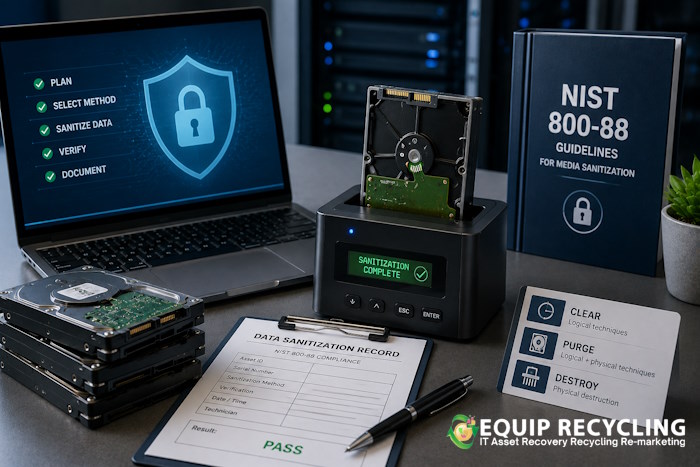
NIST SP 800-88 is the federal guideline that most IT directors, data center managers, and compliance officers eventually encounter when decommissioning equipment or managing end-of-life media. If your organization disposes of servers, hard drives, laptops, or any electronic storage, this document defines the bar you are expected to meet. It is not technically mandatory for private industry in most cases. But it is the de facto standard that auditors, regulators, and downstream partners ask about by name.
Equip Recycling works with organizations across sectors that need to demonstrate chain-of-custody compliance and verifiable data destruction. NIST 800-88 compliance. 1 is the framework we reference consistently when building destruction workflows for clients. This article breaks down what the standard actually requires, what the three sanitization categories mean operationally, and why the documentation piece matters as much as the destruction itself.
Call (866) 966-4574
The National Institute of Standards and Technology published NIST Special Publication 800-88 in 2006 and released the current version, Revision 1, in December 2014. That revision is the one still in effect and the one you should be working from.
The standard replaced the DoD 5220.22-M three-pass overwrite method as the primary reference for most organizations. DoD 5220.22-M was never updated to address solid-state storage, flash memory, or NVMe drives. NIST 800-88 Rev. 1 was designed from the start to be media-agnostic and to scale as storage technology evolves. It is the reason organizations that used to specify “DoD wipe” in their contracts have largely moved to specifying NIST 800-88 Purge instead.
The global scale of the e-waste problem underscores why this matters. Approximately 53.6 million metric tons of electronic waste were generated globally in 2019, with only 17.4% formally collected and recycled (Source: Global E-waste Monitor 2020, United Nations University). Equipment that leaves an organization without verified data sanitization does not just create a compliance risk. It becomes part of that untracked waste stream, often ending up in jurisdictions with no enforceable data protection requirements.
NIST 800-88 defines three sanitization methods. They are not interchangeable and choosing between them depends on the sensitivity classification of the data, the media type, and the intended disposition of the hardware.
Clear uses logical techniques to overwrite data in all user-addressable storage locations. Standard Read/Write commands handle the overwrite, or a factory reset is applied when overwriting is not supported. Clear is appropriate for media that will be reused internally at a lower sensitivity level. It does not address unallocated space, Host Protected Areas, or Device Configuration Overlays. For HDDs being redeployed within the same organization, Clear often meets the requirement. For anything leaving the building, it typically does not.
Purge applies physical or logical techniques that render target data recovery infeasible even with state-of-the-art laboratory methods. This is the standard that matters for most enterprise decommissioning and ITAD work.
For HDDs, Purge involves firmware-level commands that address areas outside the standard LBA address space, including defect sectors and remapped blocks. For SSDs and NVMe drives, the Purge command triggers a block erase across the entire storage array, including wear-leveled blocks that standard overwrite cannot reach. This is the critical distinction. A standard overwrite on a solid-state drive leaves recoverable data in blocks the drive controller has moved during normal wear-leveling operations. Purge addresses those areas. Overwrite alone does not.
Cryptographic erasure, where the encryption key governing a self-encrypting drive is destroyed and the drive is re-keyed, also qualifies as Purge under NIST 800-88 when implemented correctly. The key word is correctly. The encryption must have been enabled before data was written to the drive, and the key destruction must be verified and documented.
Destroy renders the media physically incapable of storing data. Physical shredding to a particle size specified by NIST, disintegration, incineration, and pulverizing are all listed. For magnetic media, degaussing followed by physical destruction is acceptable. For flash-based media, degaussing alone is not. Degaussing has no effect on NAND flash or NVMe storage. This distinction matters operationally and is still misunderstood in the field.
“We still get shipments from clients who specified degaussing for SSDs. Degaussing an SSD does nothing to the data. The NIST guidelines are explicit on this. Media type determines the applicable destruction method, not the other way around.”
— Equip Recycling
Call (866) 966-4574
NIST 800-88 Rev. 1 treats verification as a required step, not an optional quality check. The standard specifies two verification approaches. First, verification applied every time sanitization is performed. Second, representative sampling verification conducted by personnel who were not part of the original sanitization action.
This is where many organizations fall short. The sanitization was performed, the drives were shipped, and the assumption is that the work is done. But without serialized, asset-level verification, there is no auditable evidence that the destruction actually occurred or that it was applied correctly. Chain of custody documentation without verified sanitization records is incomplete documentation.
The output of a properly executed NIST 800-88 process is a Certificate of Destruction that lists each asset by serial number, identifies the sanitization method used (Clear, Purge, or Destroy), names the tools and verification methods applied, and carries a date and authorized signature. This is the document that closes the liability loop. Without it, an organization cannot demonstrate compliance if a breach investigation or regulatory audit traces back to decommissioned equipment.
According to IBM’s 2023 Cost of a Data Breach Report, the global average cost of a data breach reached $4.45 million, the highest figure ever recorded in the 18-year history of the report (Source: IBM Cost of a Data Breach Report 2023). Equipment that leaves an organization without verified data destruction is one of the more preventable contributors to that risk profile.
Top 7 Mistakes to Avoid During Data Center Decommissioning and Destruction
The wrong destruction method applied to the wrong media type is not a minor error. It is a failure to sanitize. Below is a practical mapping:
| Media Type | Clear | Purge | Destroy |
|---|---|---|---|
| HDD (magnetic) | Overwrite via R/W commands | Firmware Secure Erase, degauss | Physical shredding, disintegration |
| SSD / NVMe (flash) | Limited overwrite | Block Erase, Crypto Erase | Physical shredding (not degauss) |
| Magnetic tape | Overwrite | Degauss | Physical destruction |
| Mobile devices | Factory reset (limited) | Crypto Erase where supported | Physical destruction |
| Optical media | Not supported | Not supported | Physical destruction |
Degaussing appears in multiple categories but only for magnetic media. Applying it to flash storage is a documented error that continues to occur when procurement teams inherit old contracts specifying degaussing as a blanket method.
NIST 800-88 governs what happens to data. R2v3 certification, the current Responsible Recycling standard, governs what happens to the hardware after that. An organization choosing an ITAD vendor needs both.
An R2v3-certified facility documents its downstream vendor relationships and can demonstrate where materials go after processing. That chain of custody extends beyond the client’s dock door. Equipment that passes through an uncertified downstream vendor removes the client’s ability to demonstrate responsible disposition even if the primary vendor holds valid R2v3 status. Due diligence on the downstream is not a secondary concern.
Call (866) 966-4574
If you are managing a data center decommissioning, retiring a fleet of endpoint devices, or navigating an ITAD project that requires documented compliance, the method and the paper trail matter equally.
Equip Recycling operates under R2v3 certification and builds every destruction workflow around the NIST 800-88 Rev. 1 framework. We match sanitization method to media type, provide serialized Certificates of Destruction at the asset level, and maintain full chain-of-custody documentation from pickup through final disposition. Our downstream vendors are audited. The documentation we deliver is designed to hold up under regulatory review.
Schedule a Pickup with Equip recycling
Ready to discuss your project requirements?