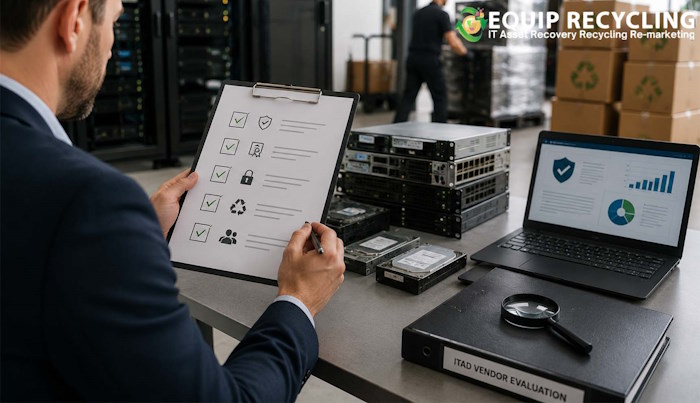
The call usually comes from legal or compliance when an old audit reveals missing documentation for a batch of drives retired months ago. In many cases, this is where ITAD becomes critical, especially as organizations face tight deadlines for data center refreshes and vendor selection. Either way, the pressure is real, and the stakes are often higher than most realize until they are already dealing with the consequences.
Equip Recycling deals with this situation regularly. Organizations that need to retire technology the right way, with documentation that holds up to scrutiny, not just a recycling receipt stapled to a work order.
Call (866) 966-4574
Vendors will tell you they’re “certified.” That word does a lot of work and covers a lot of ground. What matters is which certification, which version, and which facility it covers.
R2v3 is the current Responsible Recycling standard. Not R2:2013, not a vague reference to being “R2 compliant.” The v3 version specifically requires vendors to track material through their downstream recycling chain, vet the subcontractors handling that material, and demonstrate environmental health and safety controls across their operation. e-Stewards is a comparable standard with stricter restrictions on hazardous e-waste exports.
Ask for a copy of the current certificate. Certifications cover specific facilities, not a company as a whole, and they expire. A vendor with an R2v3 certificate at their Phoenix facility isn’t necessarily operating under those controls at a warehouse in Dallas.
ISO 14001 and ISO 27001 are worth noting but don’t substitute for R2v3. NAID AAA certification applies specifically to data destruction operations and matters if secure media sanitization is a central part of what you need.
This is where assumptions get expensive. Overwriting, degaussing, and physical shredding are three distinct methods. They apply to different media types and produce different outcomes. Treating them as interchangeable creates a real compliance gap.
NIST 800-88 Rev. 1 is the federal standard for media sanitization. It defines three approaches: Clear (overwriting), Purge (cryptographic erase or degaussing), and Destroy (physical shredding or disintegration). The right method depends on what type of media you’re dealing with and how sensitive the data is.
Overwriting works on spinning hard drives when executed correctly. It does not work reliably on SSDs, flash storage, or NVMe drives. Degaussing works on magnetic media and has no effect on solid-state. Physical shredding destroys the asset entirely, which eliminates any possibility of resale or value recovery.
Ask your vendor how they handle mixed assets, because a server cage pulled from a live data center will almost certainly contain a mix of HDDs, SSDs, and NVMe drives. If the answer is a single method applied across everything, that’s a technical problem worth pressing on.
One more thing: DoD 5220.22-M gets referenced by vendors more than it should. The DoD retired that standard in 2007. Vendors still leading with it as a primary credential are either behind on standards or using the name because clients recognize it. Mention NIST 800-88 in your RFP and see how they respond.
Call (866) 966-4574
“The vendors who cut corners on data sanitization documentation are almost never the ones who get caught immediately. The liability shows up months or years later, usually during an audit or an acquisition. By then, the drive is long gone and the paper trail doesn’t exist. That’s when the cost of doing it cheap becomes very clear.” — Equip Recycling Consultant
Chain of custody is the serialized record of every asset from the moment it leaves your facility to the moment it is sanitized or destroyed. Pickup manifests signed by your staff. Asset tagging at collection. Transportation records. Processing logs at the ITAD facility. Final disposition reporting with serial numbers.
This documentation is not administrative overhead. It is your organization’s legal protection if a retired drive surfaces later with recoverable data. The question auditors and investigators ask is not whether you used a recycler. It is whether you can prove what happened to each specific asset.
A Certificate of Destruction is asset-level documentation. It lists the device by serial number, the sanitization method used, the date, and the certifying technician or facility. A Certificate of Recycling is a different document. It confirms material was processed by a recycler but does not confirm data destruction occurred. Organizations that accept one in place of the other are carrying a compliance gap they may not know about until it matters.
According to IBM’s 2024 Cost of a Data Breach Report, the average cost of a data breach reached $4.88 million. Documented chain of custody and certified data destruction are among the more cost-effective controls available to organizations managing hardware retirement at scale.
R2v3 requires certified vendors to audit their downstream recycling partners. That means the smelters, component processors, and material recovery facilities receiving material from your ITAD vendor should be operating under recognized environmental standards. This is where greenwashing tends to show up in this industry.
Ask for the downstream vendor list. Ask what auditing process the vendor conducts. Reputable providers have this documented and will share it. Vendors who say downstream practices are proprietary or who deflect the question are communicating something worth paying attention to.
The practical reason this matters: electronics processed in unregulated facilities or improperly exported to developing countries create environmental harm and, in some cases, regulatory liability that traces back to the originating organization. RCRA hazardous waste provisions and state-level e-waste regulations don’t stop at your loading dock.
ITAD and e-waste recycling overlap but they are not the same service. ITAD includes refurbishment, remarketing, and resale of equipment that still holds market value. End-of-life recycling processes material with no viable secondary market.
A good ITAD vendor will give you an honest assessment of which equipment qualifies for remarketing. Servers three to five years old often retain real resale value. Equipment ten or more years old usually does not. Be skeptical of vendors who quote recovery numbers before they’ve physically inspected your assets. Secondary market values fluctuate and anyone promising significant returns on aging hardware without seeing it is speculating.
What you should receive is a clear, serialized accounting of which assets were resold, at what value, and how that recovery was applied against service fees or returned to your organization. If that level of reporting isn’t in the contract, ask for it specifically.
7 Easy Ways to Improve Your IT Asset Disposition (ITAD) Program
Rolling hardware refreshes and full data center decommissioning are different in scope and complexity. When the project is a full facility or server room, sequencing matters. Power-down order, cabling, physical extraction, transport staging, and on-site security during the project all require coordination that goes beyond standard pickup logistics.
A few situations that often create problems on decommissioning projects:
A vendor with real decommissioning experience will walk through these risks with you before the project starts. If they hand you a generic statement of work without project-specific planning, that’s worth flagging before you sign anything.
| Evaluation Criteria | What to Verify |
|---|---|
| R2v3 or e-Stewards Certification | Current certificate, specific facility scope |
| Data sanitization methods | NIST 800-88 compliant, media-specific approach |
| Chain of custody documentation | Serialized, asset-level, pickup through final disposition |
| Certificate of Destruction | Asset-level, includes serial numbers and method |
| Downstream vendor auditing | Documented audit process for all subcontractors |
| Value recovery transparency | Serialized resale reporting, clear settlement terms |
| Insurance coverage | Cyber liability and environmental coverage confirmed |
| Decommissioning experience | Project planning capability, not just equipment pickup |
Equip Recycling provides R2v3-certified IT asset disposition, certified data destruction, and data center decommissioning services. The work includes full chain-of-custody documentation, asset-level Certificates of Destruction, and transparent value recovery reporting on any equipment eligible for remarketing.
If you’re evaluating ITAD vendors right now, the conversation is worth starting with specifics: what equipment you’re retiring, what data sensitivity classification applies, and what compliance documentation you need at the end of the project. The team can work through that with you directly. Call (866) 966-4574.
“I was very happy with their service. It was easy to schedule the pickup, the items for recycling and the crew arrived on time. They were professional and easy to work with. The office staff was friendly and professional.”
— Anas Sheikh
“I am working with Equipment Export LLC since last 2 years and very pleased to have them as my supplier of electronic items. They are really professional people and I am very pleased with their service and professionalism.”
— Sohail Anjum