When IT directors and compliance officers start shopping for an electronics recycler, the EWaste certification question comes up fast. R2v3 sits at the top of that list, but most people do not know what it actually requires or why the gap between certified and uncertified vendors creates real legal exposure.
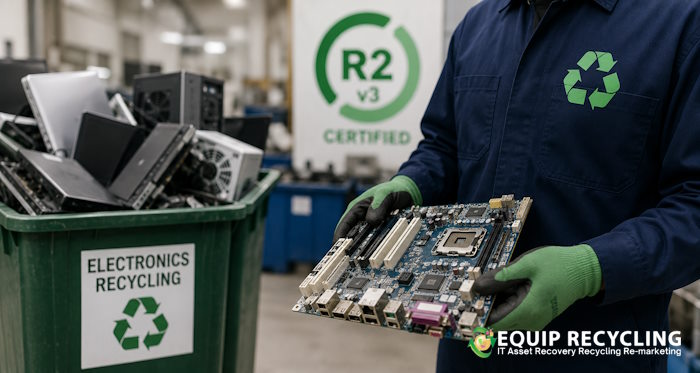
Equip Recycling holds R2v3 certification, which means every piece of electronics it processes moves through a documented, audited chain of custody from pickup to final disposition. That’s not marketing language. It’s a specific operational standard, and this article breaks down exactly what it covers.
R2v3, Responsible Recycling Version 3, is the current iteration of the electronics recycling standard developed and maintained by Sustainable Electronics Recycling International (SERI), a non-profit organization. It replaced the earlier R2:2013 standard, and all facilities that held the older certification were required to migrate to R2v3 by 2024 to stay current.
The standard applies to a broad ecosystem of operators: IT asset disposition (ITAD) providers, refurbishers, de-manufacturers, brokers, and end-of-life processors. It is accredited by the American National Standards Institute (ANSI), which puts it in the same framework as ISO-based management system standards. This is not a self-declared badge. It is a third-party-verified certification that requires annual audits to maintain.
Over 1,000 facilities across 40 countries carry R2 certification. That’s a large number, but it still represents a fraction of the global electronics recycling market. The uncertified portion is where accountability breaks down.
Call (866) 966-4574
R2v3 is structured around core requirements that apply to every certified facility, plus six appendices that address specific operation types. ITAD companies certify to Appendix B (data sanitization) and Appendix C (test and repair). Straight recyclers certify to Appendix E (materials recovery). The separation matters because the standard is applied at the process level, not just at the company level.
Core requirements cover:
The standard also requires annual third-party audits by an accredited certification body. There is no self-certification path. If an auditor finds non-conformances, the facility must remediate before maintaining certification.
This is the piece that separates R2v3 from older, lighter standards. Under R2v3, a certified facility cannot simply hand material off to a downstream vendor and walk away. They are required to vet and monitor every downstream partner handling the material, including smelters, brokers, and secondary processors.
In practice, this means a certified recycler must confirm that their downstream vendors are themselves operating to documented environmental and legal standards. They have to maintain records of that due diligence and make those records available to auditors. An R2v3-certified vendor that routes your material to an unqualified downstream processor will lose its certification. That audit pressure creates accountability all the way through the chain.
Without this requirement, a vendor can claim responsible recycling while shipping material to informal processors overseas. The 2024 Global E-Waste Monitor reports that 62 million tons of e-waste were generated globally in 2022, and only 22.3% of it was formally recycled. The rest was largely burned, dumped, or processed through informal channels with no environmental controls. Downstream due diligence is how R2v3 addresses that gap at the vendor level.
Call (866) 966-4574
Data security is where most enterprise clients focus first, and R2v3 is specific about it in ways that matter for compliance officers and IT directors.
The standard recognizes three primary data sanitization methods. They are not interchangeable, and choosing the wrong one for a given media type creates risk.
| Method | Applies To | Standard Reference |
|---|---|---|
| Logical overwrite | Functioning HDDs and SSDs with reuse potential | NIST SP 800-88 Rev. 1 (Clear or Purge) |
| Degaussing | Magnetic media (HDDs, magnetic tape) | NIST SP 800-88 Rev. 1 (Purge) |
| Physical shredding | Failed drives, SSDs, optical media, high-sensitivity classifications | NIST SP 800-88 Rev. 1 (Destroy) |
A few things worth noting. Degaussing does not work on solid-state drives. SSDs store data on NAND flash chips that are unaffected by magnetic fields. Overwriting is only effective if the drive is functional and the process runs to completion with verification. For data classified at higher sensitivity levels, the only defensible method is physical shredding, which renders the media unrecoverable.
R2v3-certified ITAD vendors are required to document which sanitization method was applied to each asset and issue a serialized Certificate of Destruction (CoD) at the device level. That CoD is your legal documentation. It is not the same as a Certificate of Recycling, which confirms that material was processed but says nothing about data destruction.
DoD 5220.22-M is still referenced in some government procurement language, but it is no longer the controlling standard for federal media sanitization. NIST SP 800-88 is the current federal guideline. If a vendor leads with DoD 5220.22-M as their primary credential, that’s worth a follow-up question.
Using an uncertified vendor is not just an environmental risk. It’s a liability question with a dollar figure behind it.
According to IBM’s 2024 Cost of a Data Breach Report, the average U.S. data breach now costs $4.88 million. A hard drive that leaves your facility without documented destruction and surfaces somewhere it shouldn’t creates breach notification obligations under state law, HIPAA, GLBA, or CMMC depending on your industry. The fact that you hired a third party to dispose of it does not transfer the liability. It can amplify it, because you cannot demonstrate due diligence if your vendor has no audited chain of custody documentation.
Extended producer responsibility (EPR) legislation has been enacted across 25 U.S. states as of 2026. In states with active EPR programs, disposal through program-approved, R2v3-certified recyclers is a documentation requirement. Vendors without current certification status cannot satisfy those chain-of-custody obligations.
R2v3 certification gives your organization a defensible paper trail. The chain of custody, the Certificate of Destruction, and the downstream vendor records are what your legal team needs if a breach investigation ever reaches your asset disposal program.
Certification claims are easy to make. Verification is straightforward. SERI maintains a public directory of currently certified facilities at sustainableelectronics.org. Check it before engaging any vendor. A facility whose certification has lapsed, been suspended, or simply never existed will not appear there.
Beyond the directory check, these are the right questions to ask:
A vendor that can answer these questions with documentation rather than generalities is operating at the level R2v3 requires.
Top Benefits for Businesses from Smarter E-Waste Management and Electronics Recycling
ITAD and recycling are related but not the same operation. ITAD, IT Asset Disposition, includes value recovery through refurbishment, resale, and remarketing alongside compliant end-of-life recycling for assets with no resale market. R2v3 covers both.
When a server or workstation has residual market value, an R2v3-certified ITAD provider will test and grade it, perform certified data sanitization, document the asset through Appendix C protocols, and route it toward reuse. When there is no value, the material goes through Appendix E processing for materials recovery. The standard accommodates both paths without compromising the documentation requirements for either.
This distinction matters for organizations trying to offset disposal costs through equipment resale. An R2v3-certified ITAD partner can tell you what your retiring assets are worth in the current secondary market and document the entire process regardless of which path each asset takes.
“R2v3 isn’t a marketing certification. It’s an operational commitment to documentation, downstream accountability, and data security that gets audited every year. When our clients hand us equipment, they need to know the chain of custody doesn’t end at our loading dock.” — Equip Recycling
Organizations in Macon’s Ingleside, Vineville, and Shirley Hills neighborhoods regularly work with Equip Recycling to manage electronics retirement, data center decommissioning, and ITAD projects that require audit-ready documentation, and can easily schedule a pickup when ready to begin. The team handles the logistics, the serialized chain of custody, and NIST 800-88-compliant data sanitization so your compliance program has what it needs from day one.
To talk through your project, call (866) 966-4574.