ESG reporting used to be a voluntary exercise in good storytelling. That’s changed. Investors are testing the claims, regulators are building disclosure requirements around them, and auditors are starting to ask for documentation that holds up under scrutiny. For sustainability leads and IT directors trying to close that gap, end-of-life IT equipment is one of the most overlooked places where real, measurable ESG impact either gets captured or quietly disappears.
Equip Recycling works with organizations across healthcare, financial services, manufacturing, and technology that need their IT disposition process to actually support the ESG commitments they’ve already made publicly. The clients who get the most out of a structured ITAD services are typically the ones who stopped treating equipment disposal as a logistics problem and started treating it as a compliance and reporting function.
Call (866) 966-4574
The organizations that seek out a structured, ESG-aligned ITAD program tend to be mid-enterprise to large enterprise companies with formal ESG frameworks already in place and hardware refresh cycles generating significant volume of end-of-life equipment. Sustainability leads and Chief Sustainability Officers typically initiate the conversation, and the data on who holds those roles nationally is worth knowing. Women now hold 58% of CSO positions in the U.S., up from 28% in 2011, according to the Weinreb Group CSO Report. That pattern holds in Equip Recycling’s own client base, where the sustainability lead driving the ITAD documentation conversation is more often a woman than a man. CFOs and legal counsel follow quickly once regulatory exposure is framed clearly, which tracks with the Thomson Reuters Institute’s 2024 State of Corporate ESG Report finding that CFOs are now central to ESG reporting success as disclosure requirements tighten.
Most organizations don’t seek out a better ITAD program until something makes the gap visible: a sustainability report cycle where they can’t produce verifiable environmental metrics, an audit that surfaces missing chain-of-custody records, or a decommissioning project that was handled informally and left no serialized documentation for specific devices.
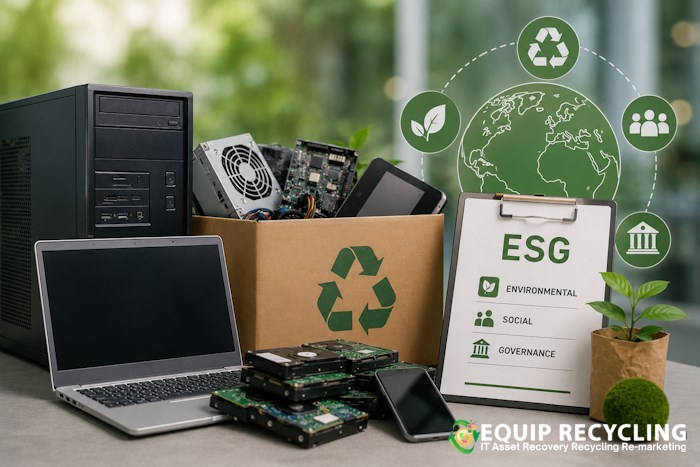
The three pillars of ESG, environmental, social, and governance, all have a direct line to how retired IT equipment is handled. Most organizations focus on the environmental piece and underestimate the other two. All three matter, and all three require specific documentation to be defensible.
The circular economy argument for responsible ITAD is legitimate, but it’s also the most frequently greenwashed part of the conversation. Saying equipment was “recycled” without documentation of what standard governed that recycling and what happened to the material downstream is not a verifiable ESG claim.
R2v3, the current Responsible Recycling standard, requires certified providers to document their downstream vendor relationships and demonstrate that materials are processed through audited facilities. That’s the baseline for any environmental claim that will survive scrutiny. Without it, you have a receipt, not a record.
Device reuse is the highest-value environmental outcome in any ITAD program. A server that gets refurbished and remarketed avoids the carbon load of manufacturing new hardware from raw materials. Rare earth elements, copper, cobalt, and gold are all embedded in enterprise equipment. According to the UN Global E-Waste Monitor 2024, published by UNITAR and ITU, the world generated 62 million metric tons of e-waste in 2022, with only 22.3% formally collected and processed in an environmentally sound manner. By 2030, the projected total is 82 million metric tons. For any enterprise with a public environmental commitment, the question of where their retired hardware went is no longer rhetorical.
This is the piece organizations most often overlook when they think about IT disposal. The social dimension of ITAD runs in two directions: what happens to the people downstream in the recycling chain, and what happens to the individuals whose data was on those devices.
Informal e-waste processing, which occurs when equipment flows into unvetted downstream markets, exposes workers to lead, mercury, cadmium, and other hazardous materials without protective controls. The World Health Organization has documented the public health consequences, and those consequences are often borne by women and children in lower-income regions. Your vendor selection has a direct effect on whether your organization’s retired equipment feeds into those informal channels or not.
On the data security side, an improperly sanitized storage device is a preventable social harm. The method of sanitization determines whether that harm is possible. NIST SP 800-88r1, the current federal guideline for media sanitization, provides a clear framework: overwrite for functioning drives headed toward remarketing, degaussing for magnetic media that won’t be reused, physical shredding for high-sensitivity environments or any device where the data classification warrants certainty. These are not interchangeable methods. Choosing the wrong one for the media type leaves exposure that no policy language will cover after the fact.
Some clients still reference DoD 5220.22-M as their compliance standard. That standard has been superseded. Presenting it to a regulator or auditor as current guidance is a risk, not a protection.
Chain-of-custody documentation is the mechanism that connects ITAD activity to ESG disclosures. Without it, what you have is a disposal process. With it, you have an auditable record.
A Certificate of Destruction documents that a specific, serialized asset was destroyed using a specified method. A Certificate of Recycling documents that material changed hands. These are different documents serving different purposes. Conflating them in an ESG disclosure is a documentation gap waiting to surface in an audit.
ESG frameworks including GRI Standards, SASB, and CDP increasingly require quantitative environmental metrics: weight of material recycled, number of devices remarketed, carbon equivalents avoided. An ITAD provider that can only produce general disposal receipts cannot support that level of reporting. Serialized, asset-level reporting is the only output that maps to those disclosure requirements.
R2v3 certification also addresses governance at the downstream vendor level. The standard requires certified providers to vet and document the partners who handle materials after primary processing. This matters because your ESG exposure doesn’t end when equipment leaves your facility or your primary vendor’s facility. If material ends up mishandled two steps downstream, the liability can still trace back to your disposal decision.
What Is the Difference Between ITAD and Electronics Recycling?
Call (866) 966-4574
| ESG Dimension | What ITAD Needs to Deliver |
|---|---|
| Environmental | R2v3-certified processing, downstream vendor documentation, reuse rate metrics |
| Social | NIST SP 800-88r1 compliant sanitization, serialized CoD per asset, vetted downstream labor practices |
| Governance | Full chain-of-custody from pickup to final disposition, asset-level serialized reporting |
Before engaging any ITAD vendor, request sample reporting. The specificity of that sample is the specificity you’ll have when an ESG auditor asks for documentation on a specific decommissioned device.
“A lot of organizations assume that because they have a recycling vendor, they have a sustainability program. Those aren’t the same thing. The difference becomes clear the first time someone needs asset-level documentation for a device that left the building two years ago.”
— Equip Recycling, ITAD Sustainability Specialists
Call (866) 966-4574
If your organization has ESG commitments tied to IT disposition, or is building toward that level of reporting, the documentation requirements need to be part of the program before the equipment leaves your facility.
Equip Recycling handles the full scope: R2v3-certified processing, NIST SP 800-88r1 compliant data sanitization across all media types, serialized chain-of-custody reporting, and downstream vendor accountability that makes ESG claims verifiable rather than aspirational.
Contact Us for more information.
Ready to close your ESG documentation gap?