In your City, we only do pickups from Commercial Businesses.
Click here to lookup the nearest BestBuy.com location or Staples.com location for Easy Dropoff.
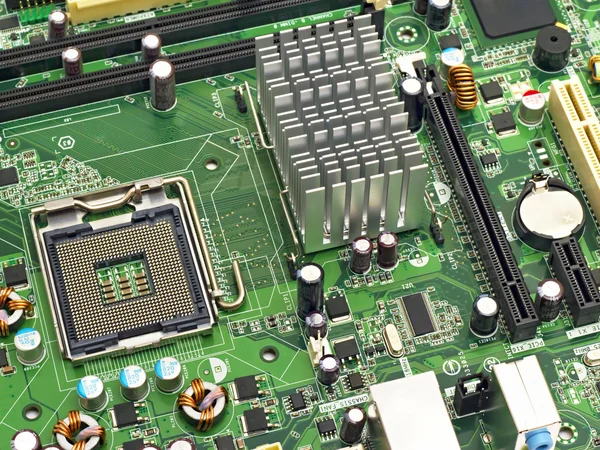
A motherboard is a type of computer hardware that acts as the main circuit board in a computer system. It is also called the mainboard, system board, or logic board. The motherboard serves as the central platform that connects and supports the different parts of a computer.
It is responsible for enabling communication between hardware components such as the CPU, RAM, storage devices, graphics card, and input/output devices. It also provides the electrical pathways and physical structure needed for these components to function together properly.
The types of motherboards vary depending on form factor, socket compatibility, and intended application. Some of the most common types of motherboards are listed below:
The components of a motherboard are listed below:
These are some of the main components found on a motherboard, although the exact layout and features may vary depending on the model, design, and intended use.
The function of a motherboard is to serve as the main circuit board of a computer, connecting and supporting all major hardware components. It provides the physical structure and electrical pathways that allow the CPU, memory, storage devices, expansion cards, and peripherals to work together.
The motherboard also plays a key role in communication and data transfer throughout the system. It houses important features such as the CPU socket, RAM slots, expansion slots, firmware chip, storage connectors, and external ports. By coordinating these elements, the motherboard helps ensure the computer operates smoothly, remains stable, and supports both basic and advanced computing tasks.
The history of motherboards reflects the steady development of computer hardware over time. It began in 1981 when IBM introduced one of the earliest motherboard designs, known as the “planar,” which included a CPU and RAM on a single board. This early version also featured wired chips and ports for peripherals such as a keyboard, mouse, and cassette tape interface.
The idea of the motherboard developed from an earlier device called the backplane. A backplane was a printed circuit board that allowed different components to connect, but it did not include processing or storage functions. The motherboard improved on this design by integrating core components directly onto the board while also supporting additional peripherals and expansion devices.
During the 1980s and 1990s, motherboards advanced significantly in design and capability. Early boards mainly provided a CPU and expansion slots, requiring users to install separate memory modules and add-on cards for many functions. As computer technology improved, more features were built directly into the motherboard, making systems more practical, more compact, and more affordable.
By the late 1980s, Super I/O chips began appearing on motherboards, adding support for more input and output functions. Entering the 21st century, motherboards commonly included built-in support for video, audio, networking, and storage, reducing the need for separate expansion cards and making system assembly easier.
Intel also played an important role in motherboard development by introducing the BTX (Balanced Technology Extended) form factor in 2004. This specification offered updated design standards focused on improved airflow, thermal control, and internal layout. Variants such as microBTX and PicoBTX were later developed to support different system sizes and use cases.
Yes, old motherboards can be disposed of by an IT Asset Disposition (ITAD) service. These providers specialize in the proper handling, recycling, and disposal of electronic equipment, including internal computer components such as motherboards.
ITAD services help ensure that old motherboards are processed in an environmentally responsible way and in accordance with applicable regulations. They may also recover reusable materials and components where possible. It is always a good idea to check with the specific ITAD (IT Asset Disposition) service provider for its exact procedures and disposal policies.
Yes, a motherboard is a type of computer hardware. It is one of the most important parts of a computer hardware component system because it serves as the main circuit board that connects the system’s major parts and allows them to communicate.
The motherboard supports essential components such as the CPU, RAM, storage drives, and other internal devices needed for the computer to function. Without it, the different hardware parts would not have a common platform for communication, power distribution, and data transfer, making normal computer operation impossible.